Five O'Clock Jingle: The Slow Vanishing of America's Most Beloved Street Vendor
Five O'Clock Jingle: The Slow Vanishing of America's Most Beloved Street Vendor
Somewhere between the late 1980s and today, an entire category of American childhood quietly disappeared. Not with a bang, not with a public debate — just a slow fade, like a radio signal losing its tower. The ice cream truck, once as reliable a feature of suburban life as Little League and screen doors, is now something most American kids know only from movies set in other decades.
That's worth stopping to think about.
The Block Erupted When the Music Started
From roughly the early 1950s through the late 1980s, the ice cream truck wasn't just a vendor — it was a neighborhood event. The moment that tinny, looping melody drifted down the street (usually a cheerful butchering of "The Entertainer" or "Turkey in the Straw"), whatever was happening stopped. Bikes were dropped mid-ride. Kickball games paused mid-inning. Kids who had been bickering two seconds earlier suddenly became a unified sprint team, all heading in the same direction.
The ritual had texture. You ran inside, yelled something only partially intelligible to a parent, grabbed whatever coins were available — a dime, a quarter, whatever lived in the junk drawer — and raced back out praying the truck hadn't turned the corner yet. If it had, you ran harder. If you caught it, you stood in line with the rest of the block and made a decision that felt genuinely weighty: Creamsicle or Drumstick? Push-Up or Fudgsicle? The vendor, usually a neighborhood fixture himself, knew the regulars by name.
For a quarter, sometimes less, you got something cold and sweet and earned entirely through your own effort. That mattered more than it sounds.
The Business Behind the Bell
The ice cream truck industry had real infrastructure behind it. Companies like Good Humor — which had been operating truck routes since the 1920s — employed thousands of drivers in crisp white uniforms who worked assigned territories like a franchise. In postwar America, with suburbs expanding rapidly and families flooding into newly built neighborhoods, the truck model made perfect sense. Families were home. Kids were outside. Routes were predictable. Profit margins were workable on volume alone.
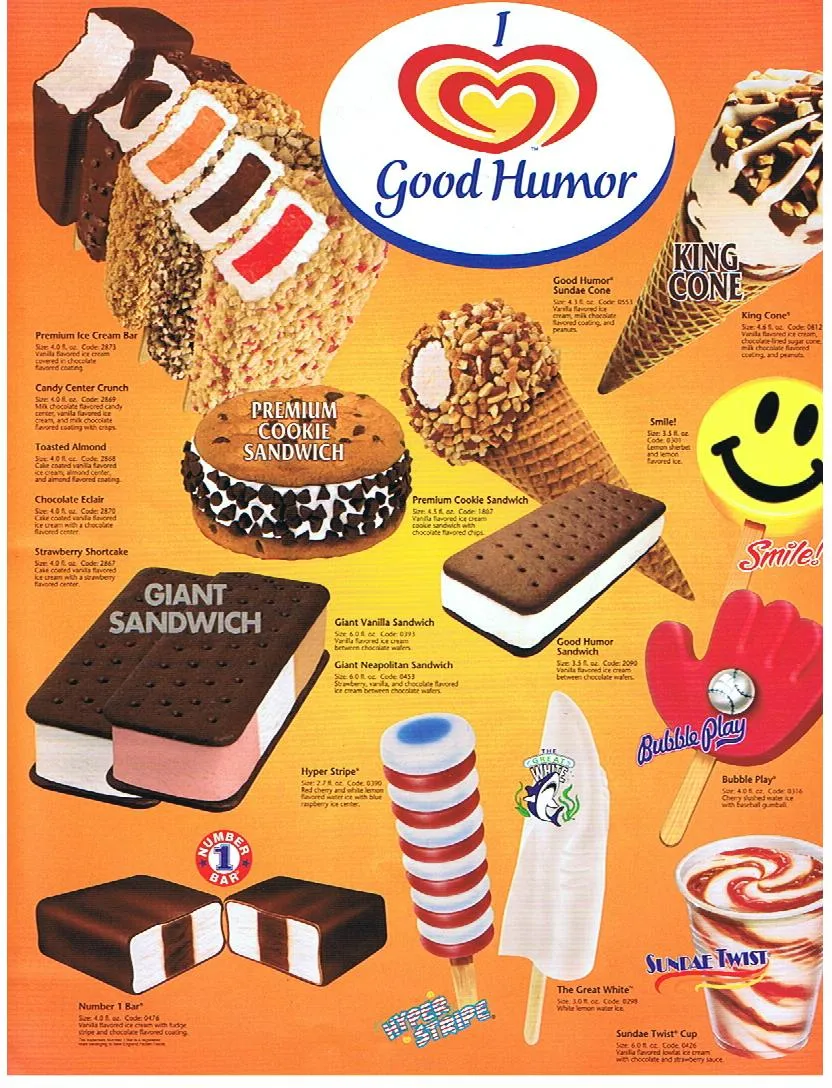 Photo: Good Humor, via 4.bp.blogspot.com
By the 1970s, the industry had diversified into dozens of regional operators, each with their own painted trucks and signature products. In some neighborhoods, two trucks from competing companies might work the same street on alternating days, which felt to kids like a kind of miracle abundance.
At its peak, the ice cream truck was a genuinely democratic institution. It didn't require a car trip. It didn't require a parent's full attention. It showed up where you already were, and it cost almost nothing.
What Changed — and Why It Matters
The decline wasn't sudden, but several forces converged in the 1990s to gut the model. Liability insurance costs for mobile food vendors climbed steeply. Fuel prices made route economics harder to justify. Suburbs sprawled outward in ways that made dense, walkable route coverage inefficient. And critically, kids stopped being outside.
That last part is the piece people don't always connect. The ice cream truck didn't just need a route — it needed an audience. It needed kids who were already on the block, unsupervised, with the freedom to hear something and chase it. As American parents grew more cautious through the late 1980s and 1990s, as organized activities replaced unstructured afternoons, and as screens began competing for attention indoors, the street emptied. A truck playing music to an empty sidewalk is just a noise complaint waiting to happen.
Today, you can order ice cream through DoorDash and have it delivered in under thirty minutes. Artisan gelato shops have colonized strip malls from Portland to Pensacola. Grocery store freezer sections offer more variety than any truck ever could. By every rational metric, the ice cream options available to an American in 2025 are vastly superior to what was on offer in 1965.
And yet something is clearly missing.
The Thing the Jingle Was Actually Selling
Here's what the ice cream truck was really about, and it had very little to do with ice cream specifically. It was about spontaneity. It was about a pleasure that arrived unannounced and required you to move, to decide quickly, to participate in something communal and public. The whole block shared the same moment. You stood in line next to the kid from two streets over you barely knew. You compared choices. You ate your Creamsicle while walking home and it melted faster than you could finish it, which was somehow part of the point.
None of that translates to a delivery app. When ice cream arrives at your door in a sealed bag, it's a transaction. When you sprinted a hundred yards in bare feet to catch a truck that was already pulling away — and caught it — it was a story.
The Trucks That Remain
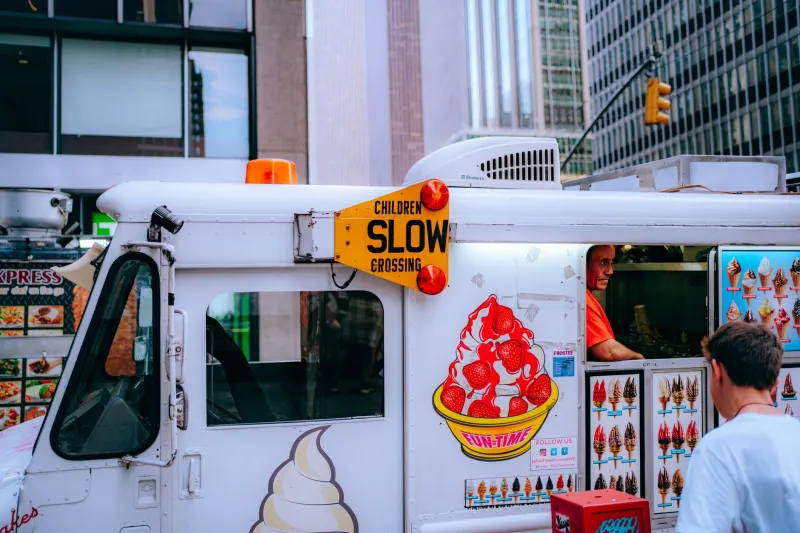
They're not entirely gone. In certain urban neighborhoods, particularly in cities with dense populations and pedestrian culture, trucks still operate. In New York, Chicago, and parts of Los Angeles, you can still hear a jingle on a summer afternoon. Some operators have modernized — accepting Apple Pay, offering dairy-free options, maintaining Instagram accounts. A handful of food entrepreneurs have tried to rebrand the concept as an upscale experience, charging eight dollars for artisan sandwiches from a vintage-painted truck.
 Photo: New York, via theplanetd.com
That's fine. But it's not the same thing, and everyone involved knows it.
The original ice cream truck worked because it was ordinary. It was cheap, it was predictable in its unpredictability, and it belonged to the neighborhood rather than to a brand. It assumed that kids would be outside, that parents would trust them to cross the street, and that a quarter was real money worth running for.
All of those assumptions are now outdated. The truck didn't disappear because we stopped wanting ice cream. It disappeared because the world it was built for gradually stopped existing — block by block, summer by summer, until the jingle finally faded out for good.