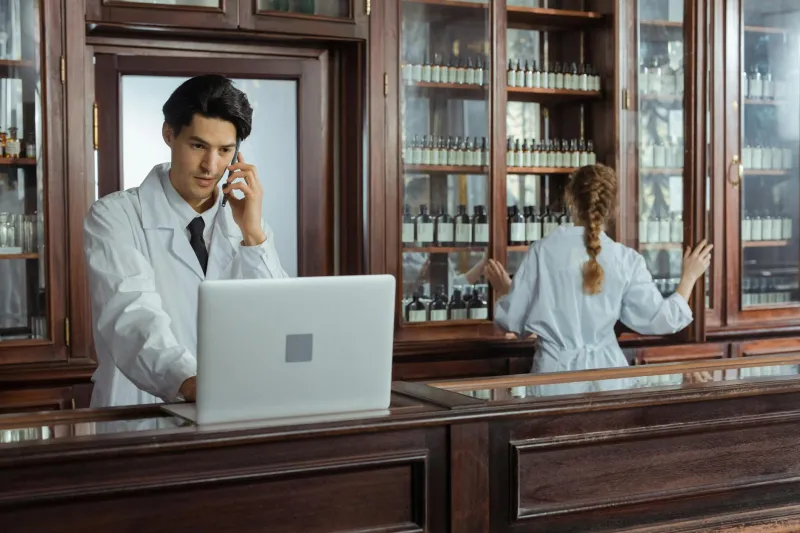
The Man Behind the High Counter
Mr. Kowalski wore the same white coat for thirty-two years behind the prescription counter at Kowalski's Pharmacy on Elm Street. He knew that Mrs. Peterson's arthritis flared up before rainstorms, that the Williams boy was allergic to penicillin, and that old Mr. Chen preferred his blood pressure medication in the morning because the evening dose kept him awake.
This wasn't unusual medical insight — it was Tuesday at the neighborhood drugstore.
Kowalski didn't just fill prescriptions; he managed the health of half the neighborhood. People brought him mysterious rashes, asked about drug interactions their doctors never mentioned, and sought advice about whether little Susie's cough warranted a doctor visit or just some honey and patience.
He was part pharmacist, part counselor, part neighborhood institution. And he was everywhere.
The Corner Clinic You Didn't Know You Had
In 1965, America had over 50,000 independent pharmacies. These weren't just places to pick up prescriptions — they were community health centers disguised as retail stores. The pharmacist typically lived in the neighborhood he served, shopped at the same grocery store as his customers, and attended the same churches.
This proximity created relationships that transformed healthcare delivery in ways we're only now beginning to understand.
When Mrs. Anderson came in looking worried about her husband's new heart medication, Mr. Kowalski didn't just hand over the bottle and process the payment. He explained how the medication worked, what side effects to watch for, and why it was important to take it with food. He knew that Mr. Anderson was stubborn about taking pills and suggested strategies for remembering the daily dose.
More importantly, he knew to check in the following week to see how things were going.
The Five-Minute Consultation
The corner drugstore consultation was a uniquely American institution. For the price of a candy bar, you could get health advice that today might cost you a $75 urgent care visit.
"Mr. Kowalski, Johnny's got this rash on his arm..."
"Looks like poison ivy. Here's some calamine lotion. Keep it clean and dry. If it spreads or he gets a fever, call Dr. Martinez."
Three minutes, fifty cents, problem solved.
These informal consultations filled a crucial gap in American healthcare. They caught problems before they became emergencies, provided reassurance for worried parents, and offered practical solutions for minor ailments that didn't warrant a doctor's visit.
The pharmacist's training in chemistry and drug interactions, combined with years of observing neighborhood health patterns, created a unique form of accessible healthcare that existed nowhere else in the system.
When Your Pharmacist Made House Calls
Many neighborhood pharmacists did more than wait for customers to come to them. Mr. Kowalski delivered medications to elderly customers who couldn't make it to the store. He'd check in on regulars who missed their usual pickup times. During flu outbreaks, he'd call customers to remind them about refills and ask how they were feeling.
These weren't billable services — they were simply what neighbors did for neighbors.
When Mrs. Chen's diabetes medication changed, Mr. Kowalski didn't just process the new prescription. He spent twenty minutes explaining how the new insulin worked, demonstrating proper injection techniques, and making sure she understood the timing. He knew her routine, her fears about needles, and exactly how to explain things so she'd actually follow through.
The Great Consolidation
The transformation started in the 1980s and accelerated through the 1990s. Chain pharmacies began buying independent stores. Insurance companies started directing patients to preferred providers. Mail-order pharmacies promised convenience and cost savings.
By 2020, just three companies — CVS, Walgreens, and Walmart — controlled over 60% of the American pharmacy market. The corner drugstore, with its personal relationships and neighborhood knowledge, became as rare as the corner blacksmith.
The efficiency gains were undeniable. Chains could process more prescriptions faster, maintain larger inventories, and offer extended hours. Computer systems could check for drug interactions more thoroughly than any human memory. Automated dispensing reduced errors and increased speed.
But something essential was lost in the translation from personal service to efficient processing.
The Drive-Through Experience
Today's pharmacy experience is optimized for speed and volume, not relationships. You pull up to a drive-through window, provide your name and date of birth, and receive a bag of medications from someone who may have never seen you before and will likely never see you again.
The pharmacist — if you see them at all — is often managing multiple locations, covering for absent colleagues, or dealing with insurance authorization issues that can take hours to resolve. The five-minute consultation has been replaced by a computer-generated printout of possible side effects that most people never read.
Questions about drug interactions or side effects get referred to "your doctor" or "the manufacturer's website." The human expertise that once bridged the gap between prescription and patient has been systematized out of existence.
What the Algorithms Can't Replace
Modern pharmacy systems can detect drug interactions with mathematical precision. They can flag allergies, track refill patterns, and generate alerts for potentially dangerous combinations. In many ways, they're more thorough than Mr. Kowalski's memory ever could have been.
But algorithms can't read body language. They can't sense when a customer is confused but too embarrassed to ask questions. They can't recognize when someone's "doing fine" actually means they're struggling with side effects but don't want to complain.
Mr. Kowalski knew that Mrs. Peterson always said she was "doing fine" when she was actually worried about something. He knew to ask follow-up questions, to check in a few days later, to notice when her usual cheerful demeanor seemed forced.
Those insights, built over years of daily interactions, created a safety net that no computer system can replicate.
The Hidden Cost of Efficiency
The move to chain pharmacies and automated systems solved real problems. It reduced medication errors, improved inventory management, and made prescriptions more affordable for many Americans. But it also eliminated one of the most accessible sources of health guidance in American communities.
The elderly customer who once got gentle reminders about medication timing now struggles with complex pill schedules alone. The worried parent who once got reassuring advice about childhood illnesses now faces expensive urgent care visits for minor concerns. The chronic disease patient who once had a knowledgeable advocate helping navigate treatment changes now deals with rotating staff who know nothing about their medical history.
The Neighborhood We Can't Rebuild
We can't return to the era of Mr. Kowalski's Pharmacy. The economics don't work, the regulations have changed, and the healthcare system has evolved in ways that make the corner drugstore model nearly impossible to replicate.
But recognizing what we lost might help us figure out what we need to rebuild. The personal relationships, the accessible expertise, the community knowledge that once made healthcare more human — these elements didn't disappear because they were worthless. They disappeared because we couldn't figure out how to preserve them while pursuing efficiency and scale.
The Prescription for Connection
Some independent pharmacies still exist, and some chain pharmacists still manage to build relationships with regular customers despite corporate constraints. These exceptions prove that the human element in healthcare isn't obsolete — it's just harder to maintain.
The challenge isn't returning to 1965, but figuring out how to capture the best of Mr. Kowalski's approach in 2025's reality. How do we create systems that are both efficient and personal? How do we preserve the human expertise that once made every neighborhood drugstore a informal health clinic?
Because somewhere between the corner pharmacy and the drive-through window, we lost more than just convenience. We lost the neighbor who knew our names, understood our fears, and cared enough to check on us when we didn't show up for our usual prescription refill.
That kind of care, it turns out, might have been the best medicine of all.