When Every Kid Was a Neighborhood Regular: How American Childhood Lost Its Freedom
When Every Kid Was a Neighborhood Regular: How American Childhood Lost Its Freedom
Picture this: It's 1978, and eight-year-old Tommy leaves his house after breakfast with nothing but a pocketful of change and a stern warning to "be home when the streetlights come on." He'll spend the next ten hours building a fort in the woods behind the Johnsons' house, riding bikes to the creek with kids from three different streets, and maybe getting into a minor scuffle over who gets to be Luke Skywalker during their Star Wars reenactment. No adult will check on him. No one will call his mother. This was just Tuesday.
Fast-forward to today, and that same scenario would probably result in child protective services being called and Tommy's parents facing serious questions about neglect.
The Great Outdoor Republic of Childhood
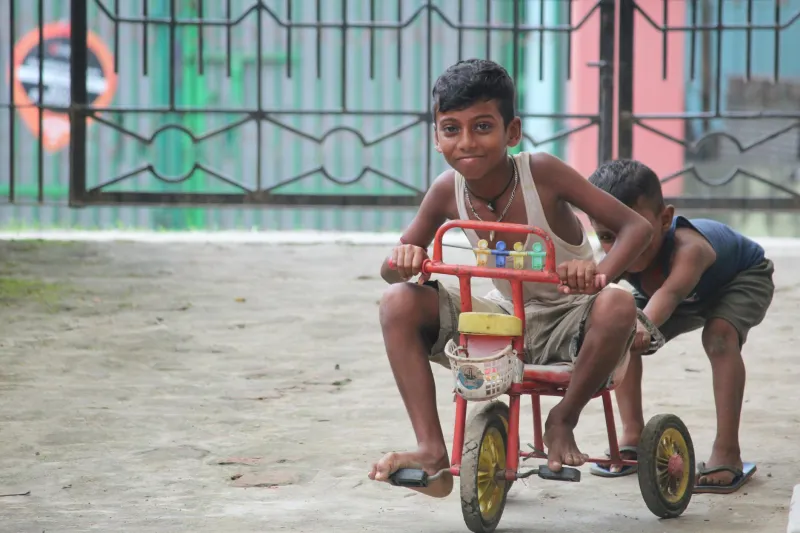
For most of the 20th century, American neighborhoods functioned as extended playgrounds where children operated with a level of independence that seems almost mythical today. Kids as young as five or six would leave home in the morning and return only for meals, creating elaborate games that spanned multiple yards and sometimes entire blocks.
These weren't just random adventures — they were sophisticated social ecosystems. Children developed their own hierarchies, rules, and traditions. The older kids taught the younger ones everything from how to catch fireflies to which houses had the best Halloween candy. Disputes were settled through elaborate negotiations or, occasionally, brief scuffles that were forgotten by dinnertime.
"We had this whole world that adults barely knew about," remembers Sarah Chen, now 52, who grew up in suburban Chicago. "There were secret paths through people's yards, hiding spots we'd discovered, and this unspoken understanding that certain places belonged to us during certain hours."
When Danger Lurked in Statistics, Not Headlines
The irony is that childhood was statistically more dangerous in those days. In 1975, the child mortality rate was nearly twice what it is today. Kids rode bikes without helmets, played on metal playground equipment that could give you tetanus just by looking at it wrong, and nobody had heard of car seats extending past age two.
Yet parents worried less. The difference wasn't that dangers didn't exist — it's that they weren't constantly broadcast into living rooms through 24-hour news cycles. A kidnapping three states away didn't feel like a threat to your own neighborhood because you simply didn't hear about it.
"My mother had no idea where I was most of the time, and that was completely normal," says Mike Rodriguez, who grew up in Phoenix in the 1980s. "She knew I was 'somewhere in the neighborhood,' and that was specific enough."
The Rise of Helicopter Parenting
The shift began gradually in the 1990s and accelerated dramatically after 2000. Several factors converged to create what researchers now call "paranoid parenting." Cable news made distant dangers feel immediate. The internet amplified every possible threat. And perhaps most significantly, American culture began treating children less like resilient little humans and more like precious, fragile treasures.
Scheduled activities replaced spontaneous play. Playdates became formal arrangements requiring parental coordination. The phrase "stranger danger" entered the vocabulary, even though statistics showed that children were far more likely to be harmed by someone they knew than by a random person.
Screen Time vs. Creek Time
Today's children live in a world that previous generations would find bewildering. The average American kid spends over seven hours a day looking at screens — more time than many adults spend at their jobs. Meanwhile, outdoor play has dropped by 50% since the 1970s, and many children can identify more corporate logos than local plants or animals.
The trade-offs are complex. Modern children are arguably safer, more educated, and have access to incredible resources through technology. They can video chat with grandparents across the country and learn about ancient Rome through immersive apps.
But researchers worry about what's been lost. Studies suggest that unstructured outdoor play is crucial for developing problem-solving skills, physical coordination, and emotional resilience. Children who don't experience minor risks and challenges may struggle more with anxiety and decision-making as adults.
The Free-Range Rebellion
Some parents are pushing back. The "Free-Range Kids" movement, started by author Lenore Skenazy, advocates for giving children more independence. Several states have passed laws protecting parents who let their kids walk to school alone or play in parks unsupervised.
But these parents often face criticism from other adults. In 2015, a Maryland couple was investigated by child protective services for letting their 10 and 6-year-old walk home alone from a park — something that would have been unremarkable in 1975.
What We've Gained and Lost
Today's structured childhood has clear benefits. Kids are more likely to develop specialized skills through organized activities. They're safer in measurable ways. And they have access to educational opportunities that previous generations couldn't imagine.
But something ineffable has been lost in the translation from street to screen. The ability to navigate social conflicts without adult intervention. The confidence that comes from exploring beyond your immediate surroundings. The deep satisfaction of creating something from nothing but imagination and whatever materials you could scrounge up.
"We're raising the safest generation of children in human history," notes Dr. Peter Gray, a research professor at Boston College who studies children's play. "But we might also be raising the most anxious."
The challenge for modern parents isn't necessarily to return to 1975 — most of us wouldn't want to give up car seats and bike helmets. But perhaps there's a middle ground where children can experience both safety and freedom, where neighborhoods can once again become places where kids are regular citizens rather than rare, supervised visitors.
After all, some of life's most important lessons can't be scheduled or supervised. They happen in the spaces between adult oversight, in the moments when children have to figure things out for themselves. And those lessons might be too valuable to lose entirely to our well-intentioned fears.