Fold It Right and You'll Never Get Lost: What the Road Atlas Taught America About Itself
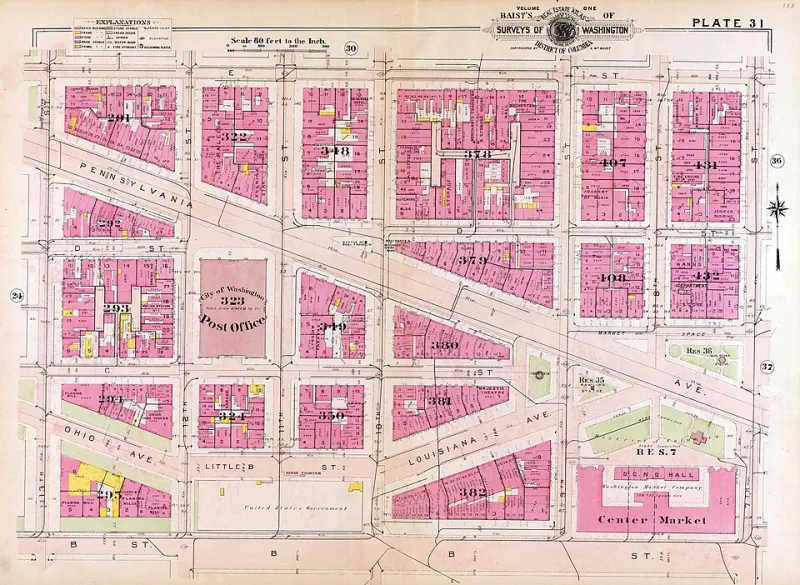
Photo: George William Baist, Public domain, via Wikimedia Commons
Fold It Right and You'll Never Get Lost: What the Road Atlas Taught America About Itself
Ask the average American driver today to describe the basic geography between, say, Nashville and Kansas City — what states they'd pass through, what rivers they'd cross, roughly how the land changes along the way — and you'll often get a blank stare followed by "I'd just use Google Maps." That answer is completely reasonable. It's also a small signal of something that got quietly lost over the past twenty-five years.
For most of the twentieth century, Americans who drove long distances developed something that's genuinely hard to recreate through a screen: a physical, intuitive sense of how the country was laid out. They got it from road atlases — those thick, spiral-bound books of state-by-state maps that lived in glove compartments, backseat pockets, and the bottom of every family's road trip bag. And the knowledge they built from those maps was more durable than anything a navigation app can provide.
The Atlas as American Artifact
Rand McNally published its first road atlas in 1924, and by the postwar boom years it had become as standard a piece of American car equipment as a spare tire. The annual editions sold millions of copies. Gas stations stocked them. AAA distributed customized versions to members. Families updated theirs every few years the way they updated the encyclopedia — with a sense that the current version was an important document worth maintaining.
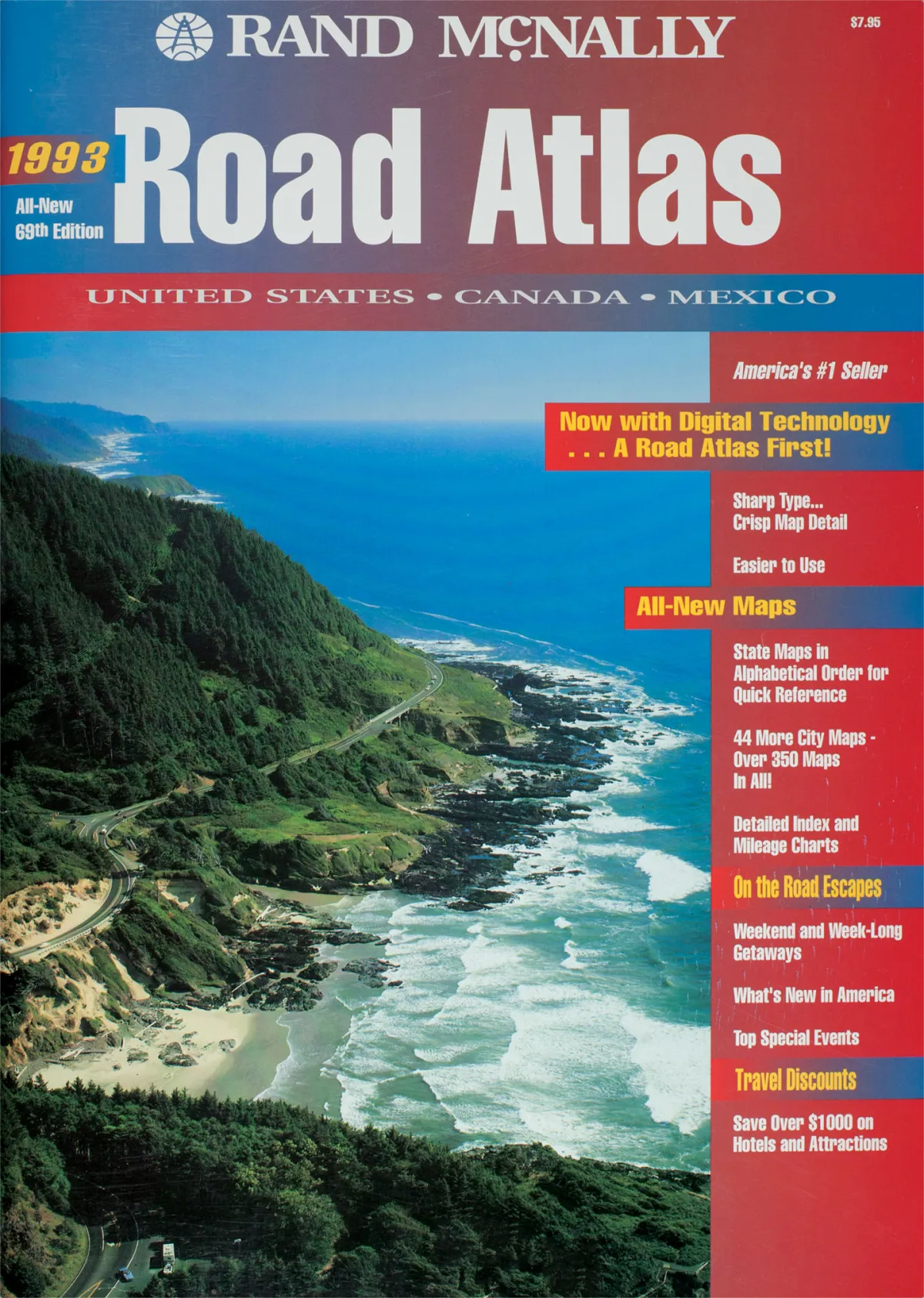 Photo: Rand McNally, via help.randmcnally.com
The physical experience of using a road atlas was nothing like tapping a destination into a phone. You spread the book across your lap or on the hood of the car, found your state, traced your route with a finger, then flipped to the next state and did it again. Planning a trip from Chicago to Denver meant touching six or seven pages, absorbing the relative scale of each state, noticing which cities sat on which rivers, observing that Kansas was wider than it looked and Colorado's eastern half was nothing like its western half.
None of that information was delivered to you. You assembled it yourself, piece by piece, and that assembly process is exactly what made it stick.
Navigation as Geographic Education
There's a meaningful difference between knowing your route and understanding your route. A GPS gives you the first. A road atlas, used properly, gave you the second.
When you navigated by atlas, you developed reference points that accumulated over years of driving. You knew that I-80 was the northern transcontinental backbone and I-40 was the southern one. You knew that the Mississippi was wider and more significant than most people imagined until they crossed it. You knew that West Texas went on forever and that the Appalachians created a natural seam down the eastern third of the country. These weren't facts you memorized — they were impressions you gathered from repeated physical engagement with maps.
The result was a population of drivers who had a genuine mental model of the United States as a physical place. Truckers developed this to an almost encyclopedic degree — many long-haul drivers of the atlas era could recite highway connections across multiple states from memory. But even ordinary families who took one or two road trips a year built up a real sense of the country's shape and scale in ways that passive GPS navigation simply doesn't produce.
The Co-Pilot Was a Real Job
The atlas era also created a specific social role that has essentially vanished: the navigator. On any road trip of consequence, someone in the passenger seat was responsible for the map. This person tracked progress, anticipated upcoming exits, warned the driver about upcoming route changes, and managed the translation between the abstract lines on the page and the actual road unfolding ahead.
It required genuine engagement. You had to hold the map oriented correctly relative to your direction of travel. You had to read highway numbers on green signs fast enough to confirm you were on the right road. You had to estimate distances — "we've got about forty miles before the junction" — based on the map's scale. When something didn't match up, you had to figure out why, which usually meant either a mistake in your reading or a road that had changed since the atlas was printed.
This was not always smooth. Plenty of family arguments were conducted over open road atlases in moving vehicles. But those arguments were also geography lessons. The process of figuring out where you went wrong required understanding where you actually were, which required knowing how the roads connected, which required a mental map that kept getting more detailed every time you drove somewhere new.
What GPS Actually Changed
Turn-by-turn GPS navigation arrived as a consumer product in the early 2000s and became standard on smartphones by the late 2000s. The convenience was immediate and undeniable. You typed in an address and a voice told you exactly what to do. No folding, no squinting, no co-pilot arguments. Route optimization happened automatically. Traffic rerouting happened in real time. By almost every practical measure, it was a massive improvement.
But the improvement came with a trade. When navigation is fully outsourced to a device, the driver's role becomes purely mechanical — follow the instruction, make the turn, arrive at the destination. The geography between Point A and Point B becomes irrelevant. You don't need to know what state you're in. You don't need to know whether you're heading north or south. You don't need to understand how the roads connect, because the device handles all of that invisibly.
Studies on spatial cognition have found exactly what you'd expect: people who rely heavily on GPS navigation develop weaker mental maps of the areas they drive through regularly. The hippocampus — the brain region associated with spatial memory — shows less engagement during GPS-guided navigation than during self-directed navigation. You arrive at your destination, but you don't really know where you've been.
The Country Behind the Directions
What the road atlas gave Americans was a relationship with the physical reality of their country — not as a political abstraction or a collection of landmarks, but as a landscape with actual dimensions, actual connections, actual geography that explained why certain cities existed where they did and why certain routes made sense.
Knowing that St. Louis sits at the confluence of the Missouri and Mississippi rivers isn't trivia when you've traced that junction on a map. Knowing that the Rocky Mountains create a genuine barrier that forces every transcontinental route to choose its crossing point carefully gives you a different understanding of American history than any textbook provides. The atlas made that knowledge tactile.
None of this means GPS is bad. It's extraordinary technology that prevents accidents, saves time, and makes driving accessible to people who would have struggled with maps. But the atlas-era road warrior who could describe the terrain between Dallas and Albuquerque from memory had something worth acknowledging — a genuine, embodied understanding of the country they lived in.
The glove compartment atlas didn't just show you how to get somewhere. It slowly, trip by trip, taught you where you were.