The 4 O'Clock Music That Made Every Kid Drop Everything and Run
The 4 O'Clock Music That Made Every Kid Drop Everything and Run
There was a sound that could stop time in American neighborhoods. Not a siren or a bell, but something sweeter — the tinkling melody of "Turkey in the Straw" or "The Entertainer" drifting down the street at exactly the right moment. Every kid within six blocks knew what it meant, and they'd drop whatever they were doing to join the daily pilgrimage.
 Photo: Turkey in the Straw, via kubrick.htvapps.com
The ice cream truck wasn't just a business. It was the heartbeat of summer, the soundtrack of childhood, and the one thing that could unite an entire street in pure, uncomplicated joy.
The Pavlovian Response of Pure Happiness
You'd hear it first as a whisper, barely audible over the sound of sprinklers and lawnmowers. Then it would get closer, that familiar melody growing stronger, and suddenly every screen door in the neighborhood would slam shut as kids came running. They'd emerge from backyards, basement playrooms, and bedroom hideouts, clutching crumpled dollar bills and pocket change.
The music had a magical quality — it could pull children away from television shows, video games, or whatever trouble they'd been getting into. Parents learned to recognize the sound too, reaching for their purses without being asked, understanding that this was one of those small childhood experiences worth a few quarters.
In the Martinez household on Oak Street, seven-year-old Lisa had the routine down to a science. The truck hit their block every weekday at 4:15 PM, right after her afternoon cartoons ended. She'd position herself by the front window at 4:10, listening for those first faint notes. The moment she heard them, she'd yell "Ice cream truck!" and the whole house would spring into action.
 Photo: Oak Street, via i.pinimg.com
The Mobile Democracy of Summer
The ice cream truck was beautifully democratic. Rich kids and poor kids lined up together, everyone equal in their desire for a Bomb Pop or a Drumstick. The truck driver — usually a patient soul named Tony or Miguel or Mrs. Johnson — knew every kid's name and their usual order. He'd remember that Emma always got the strawberry shortcake bar, that the Thompson twins shared a single ice cream sandwich, and that little Marcus was allergic to nuts.
This wasn't just commerce; it was community building. Kids who might not otherwise talk would find themselves standing together in line, comparing choices, trading quarters for dimes. Older kids would help younger ones reach the window. Shy children would whisper their orders to more confident friends.
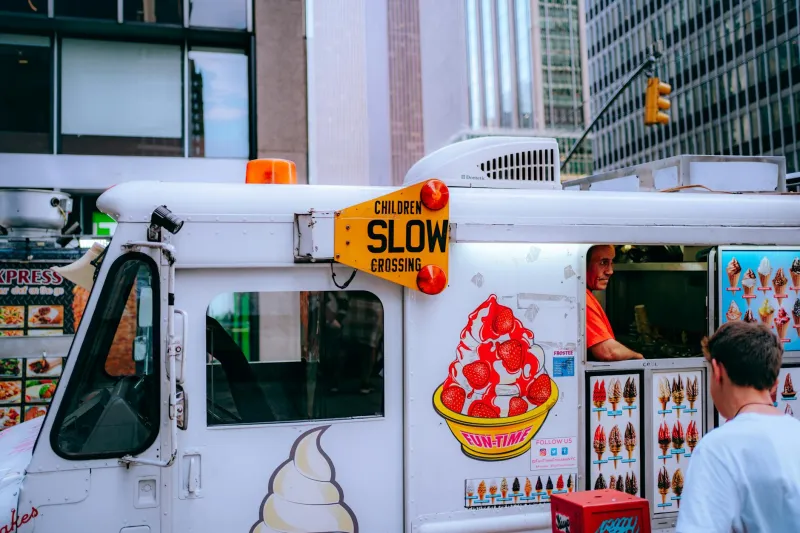
The truck itself was a marvel of mobile engineering — a freezer on wheels decorated with cartoon characters and pictures of every available treat. The driver would slide open that magical window and reveal a wonderland of frozen possibilities: Popsicles in impossible colors, ice cream sandwiches wrapped in paper, novelty bars shaped like cartoon characters, and the holy grail of summer treats — the soft-serve cone with the curl on top.
The Rhythm That Organized Neighborhoods
Every truck had its route, as predictable as the mail delivery. Maple Street at 3:45, Oak Street at 4:15, Elm Street at 4:45. Kids learned these schedules by heart, planning their afternoons around the arrival of frozen happiness. Parents could set their clocks by it.
This predictability created a shared rhythm for entire neighborhoods. Mothers would time their grocery runs to avoid missing the truck. Kids would negotiate with friends about whose street to wait on. Grandparents visiting for the summer would be amazed that their grandchildren could predict the truck's arrival down to the minute.
The route connected streets that might otherwise have felt separate. Kids from different blocks would meet at the boundary lines, creating temporary friendships based on mutual ice cream appreciation. The truck driver became a neighborhood celebrity, someone everyone knew but who remained mysteriously separate from the usual social hierarchies.
When Summer Had Its Own Soundtrack
Those tinkling melodies became the official soundtrack of American summer. "Turkey in the Straw" meant freedom, adventure, and the promise that today might be special. The music was deliberately cheerful, designed to travel far enough to reach every potential customer but not so loud as to annoy the adults.
Some trucks played the same song over and over. Others had a repertoire of three or four melodies that they'd cycle through. Kids developed preferences — the truck that played "The Entertainer" was somehow more sophisticated than the one stuck on "Pop Goes the Weasel." But any ice cream truck music was good ice cream truck music.
The sound created its own geography of anticipation. You'd hear it in the distance and start calculating — was it coming your way or heading to the next neighborhood? Should you run toward the sound or wait for it to come to you? The music created a map of possibilities that existed nowhere else in childhood.
The Death of the Daily Route
Sometime in the 1990s and 2000s, the ice cream trucks began to disappear. Not all at once, but gradually, like so many other pieces of American neighborhood life. The economics got harder — rising gas prices, stricter regulations, changing insurance requirements. Suburban sprawl created neighborhoods without sidewalks, where kids didn't play outside as much.
Parents became more protective, less likely to let children run unsupervised toward a stranger's truck. The rise of organized activities meant fewer kids were home at 4 PM anyway — they were at soccer practice or piano lessons or daycare. The informal, unstructured summer that had sustained the ice cream truck tradition was quietly disappearing.
Today's kids get their frozen treats delivered through apps. DoorDash will bring you ice cream in 20 minutes, and it'll probably be better quality than anything that came off the truck. But it arrives silently, in a plastic bag, handed over at the front door without ceremony or community.
What Melted Away
The ice cream truck represented something that's hard to replicate in our on-demand world: the joy of anticipation, the sweetness of shared experience, and the magic of treats that had to be earned through patience and timing. It was one of the last remnants of a world where children's lives followed natural rhythms rather than scheduled activities.
When the trucks disappeared, neighborhoods lost one of their few remaining gathering points. The daily moment when strangers became neighbors, when different families intersected around something purely joyful, when the whole street shared the same simple pleasure.
Every now and then, in certain neighborhoods, you'll still hear that familiar melody drifting down the street. And for just a moment, time stops. Adults remember being seven years old and running toward happiness. Kids discover what their parents are talking about when they get that distant look and say, "When I was your age..."
The ice cream truck was never really about ice cream. It was about the magic of anticipation, the democracy of childhood desire, and the simple pleasure of sharing something sweet with your neighbors. We can order better ice cream now, faster and more conveniently than ever before.
But we can't order back the feeling of an entire street coming alive at 4 PM, united by nothing more than the promise of a Rocket Pop and the sound of summer calling their names.