The $2 Shave and a Story: When America's Barbers Were the Original Life Coaches
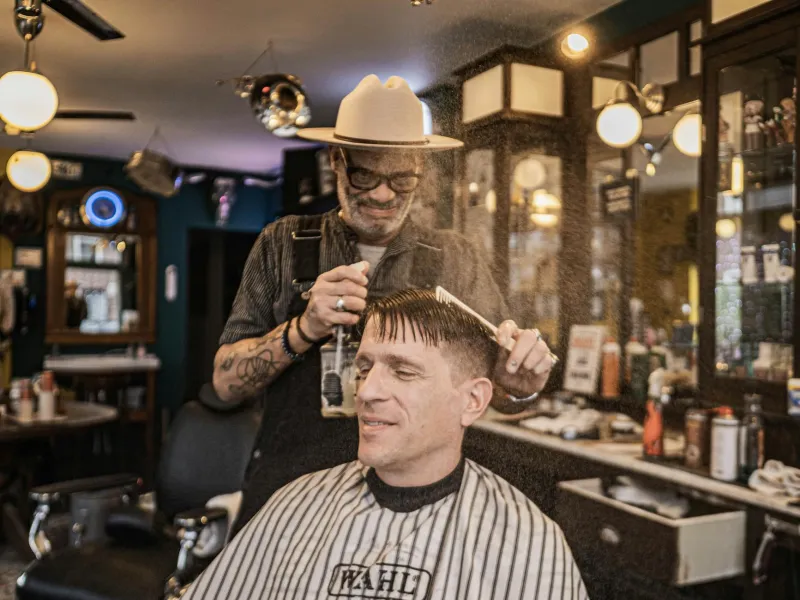
The Chair That Knew Your Troubles
Walk into any Great Clips or Sport Clips today, and you'll find efficiency. Twelve minutes, maybe fifteen if you're lucky. The stylist might ask about your weekend, but they're already reaching for the next customer's cape before you've answered. It's haircuts as commodity — fast, functional, forgettable.
But step back sixty years, and that same simple haircut was something entirely different. It was ritual. It was community. It was the closest thing to therapy most American men would ever experience.
Where Everyone Knew Your Name (and Your Business)
The neighborhood barbershop wasn't just a place to get groomed — it was democracy in action. Every town had at least one, usually tucked between the hardware store and the five-and-dime, with a red-white-blue pole spinning outside like a beacon for masculine communion.
Inside, the scene played out the same way from Maine to California. Three or four leather chairs, each one a throne where regular customers held court. Mirrors that reflected not just faces but decades of conversation. And always, always, the barber who knew everyone's story.
Take Joe DiMarco's shop in Cleveland, circa 1962. For forty-three years, Joe cut hair on Lorain Avenue, and in that time he became confessor to half the neighborhood. Men would sit in his chair and unload their troubles — the factory closing, the wife's illness, the son who wouldn't write from Vietnam. Joe would nod, snip, and offer the kind of practical wisdom that came from listening to human nature for four decades.
The haircut itself? That was almost secondary. Sure, you'd walk out looking sharp, but you'd also walk out feeling heard.
The Rhythm of Real Conversation
There was no rushing at the old barbershop. A proper cut took forty-five minutes, sometimes an hour if the conversation was good. The barber would take his time with the hot towel, the straight razor, the careful trimming around the ears. Every step was deliberate, unhurried.
This wasn't inefficiency — it was investment. In that chair, men talked about things they couldn't discuss anywhere else. Politics, sure, but also fears, dreams, the small disappointments that make up most of life. The barber's chair was Switzerland — neutral territory where Democrats and Republicans could argue about Kennedy without coming to blows.
Meanwhile, other customers waited their turn, reading yesterday's newspaper or joining the conversation from the wooden bench along the wall. It was theater, really. Everyone had a role to play, and everyone knew their lines.
When $1.50 Bought You the World
The economics were beautiful in their simplicity. A haircut cost $1.50, maybe $2.00 if you wanted the full treatment with a shave. That was real money in 1960 — about what you'd pay for a decent lunch — but it bought you so much more than grooming.
It bought you belonging. It bought you an hour of human connection in a world that was already starting to feel too fast, too impersonal. It bought you the kind of continuity that comes from sitting in the same chair your father sat in, getting your hair cut by the man who cut your father's hair.
Compare that to today's salon experience. The average haircut costs $35, takes twelve minutes, and involves more small talk with a stranger than genuine conversation with a neighbor. The stylist is perfectly pleasant, but they don't know that you're worried about your mother's memory or proud of your daughter's college acceptance letter. They're not invested in your story — they're just trying to get through their shift.
The Death of the Neighborhood Sage
Somewhere between 1975 and 1995, America's barbershops began disappearing. Chain salons moved in with their efficiency models and gender-neutral approach. The old barbers retired, and their sons became accountants or engineers instead of learning the trade.
We gained convenience and lost communion. We gained speed and lost stories. We gained uniformity and lost the beautiful chaos of neighborhood characters who knew everyone's business and somehow made that feel like blessing rather than burden.
What We Traded Away
Today's men get their hair cut in sterile environments where the biggest decision is whether to tip through the app or in cash. The experience is optimized for throughput, not connection. The stylist wears earbuds, the client checks his phone, and everyone pretends this is progress.
But what did we really gain by turning haircuts into drive-through transactions? We saved time, certainly. We eliminated the inefficiency of human conversation. We created a service economy where everything is measured and optimized and reduced to its most essential function.
We also eliminated one of the last places where American men could be vulnerable with each other. Where they could admit uncertainty, seek advice, or simply sit still long enough to remember who they were underneath all the rushing around.
The old barbershop wasn't just about hair — it was about the radical idea that everyone deserves to be known, to be heard, to matter to someone beyond their immediate family. It was therapy disguised as grooming, community disguised as commerce.
And for $1.50, it was the best deal in town.