The Man Behind the Counter Who Knew Your Whole Family's Business
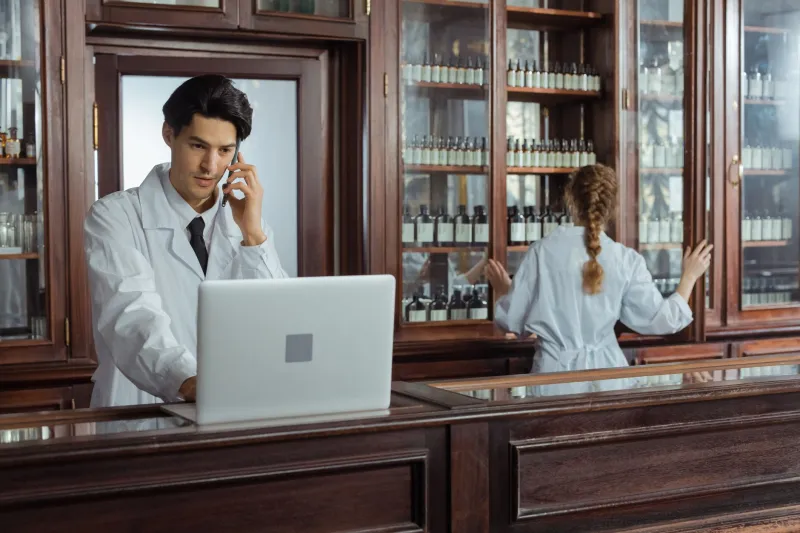
Walk into a chain pharmacy today and you'll know the drill. You hand over your insurance card, wait fifteen minutes in a plastic chair under fluorescent lights, and collect a white paper bag from someone who will not make eye contact. There's a sticker on the bottle with instructions. There's a printout the size of a CVS receipt explaining side effects. And then you're done.
It wasn't always like this.
The Corner Drugstore Was a Different Kind of Institution
For much of the twentieth century, the neighborhood pharmacy was less a retail outlet and more a fixture of community life. The pharmacist — often the owner, often someone whose family had run the place for a generation — was a trusted figure in the same way a family doctor or a local priest might be. People stopped in not just to pick up a prescription but to ask questions, get opinions, and sometimes just talk.
These were small operations, typically. A soda fountain in the front, a counter in the back, and a pharmacist who had probably compounded your grandmother's arthritis cream from scratch. He — and it was usually a he, in those decades — kept paper records that amounted to an informal medical history for every family on the block. He knew your allergies without being prompted. He'd remind you that a medication you were picking up might interact badly with something else you'd filled the month before.
This wasn't a system. It was a relationship.
What Efficiency Replaced
The consolidation of American pharmacy began in earnest in the 1980s and accelerated sharply through the 1990s. Chain stores expanded, independent pharmacies closed, and the economics of prescription volume replaced the economics of neighborhood trust. By the time the internet arrived, the transformation was already well underway.
Today, the three largest pharmacy chains in the United States — CVS, Walgreens, and Rite Aid — collectively operate tens of thousands of locations. Add in mail-order fulfillment services, grocery store pharmacy counters, and app-based prescription delivery, and the modern American has more ways to access medication than at any point in history. That's genuinely good news. Access matters. Speed matters. Cost — when insurance cooperates — has improved for many people.
But something real was traded away in that bargain.
The Health Literacy Gap Nobody Talks About
When your pharmacist knew you, you got information calibrated to your situation. Not a printout. Not a pop-up on a website. An actual conversation with someone who understood your medical context and could speak plainly about what you were putting in your body.
Research has consistently shown that patients who understand their medications take them more correctly, experience fewer adverse events, and manage chronic conditions more effectively. The neighborhood pharmacist was, in practice, a front-line health educator. He filled in the gaps between doctor visits. He caught errors. He talked nervous patients down from unnecessary worry and flagged real concerns that might otherwise have gone unnoticed.
Now consider the average pharmacy interaction in 2024. A technician — not a pharmacist — processes most transactions. The pharmacist on duty may be managing hundreds of prescriptions per shift. Consultation windows exist in theory; in practice, they're rarely used and often awkwardly positioned near the checkout line. The three-minute conversation that might have caught a dangerous drug interaction simply doesn't happen at scale.
The Trust Economy That Quietly Collapsed
There's a cultural dimension here that goes beyond medicine. The neighborhood pharmacist occupied a specific role in American civic life — someone with professional expertise who was also your neighbor, who had skin in the game of your community's wellbeing. That role has largely evaporated.
When people lost that relationship, many of them didn't replace it with anything. They Googled. They asked Reddit. They self-diagnosed and self-medicated in ways that ranged from harmless to genuinely dangerous. The vacuum left by the trusted local expert didn't stay empty — it filled with noise.
It's worth noting that some independent pharmacies still operate this way. In smaller towns and tight-knit urban neighborhoods, you can still find a pharmacist who knows your name and asks follow-up questions. These places tend to inspire fierce loyalty among their customers, which tells you something about what people actually want.
Speed Is Not the Same as Care
Nobody is arguing that the old system was perfect. It wasn't. Compounding errors happened. Bias existed. Access was uneven, and if you didn't live near a good independent pharmacy, you were out of luck. The democratization of pharmaceutical access that came with chain expansion genuinely helped millions of Americans.
But there's a difference between acknowledging progress and pretending nothing was lost. The transaction model that dominates modern pharmacy is fast, scalable, and largely anonymous. The relationship model it replaced was slower, more personal, and grounded in something that's genuinely hard to replicate at corporate scale: the sense that someone was actually paying attention to you.
The next time you pick up a prescription, notice what the experience asks of you. It asks you to wait, to sign, and to leave. It doesn't ask how you're doing. It doesn't remember that you're allergic to sulfa drugs. It doesn't know your kids' names.
Somewhere along the way, we decided that was fine. It's worth at least wondering if it is.