The $12 Shirt and the 81-Pound Problem: How Americans Stopped Valuing Their Clothes
The $12 Shirt and the 81-Pound Problem: How Americans Stopped Valuing Their Clothes
Walk into a fast fashion retailer today and you can leave with a full outfit — shirt, pants, maybe a jacket — for less than the cost of a restaurant lunch. The fabric is thin. The stitching is serviceable at best. In three months, something will likely go wrong with it. In six months, you probably won't want it anymore anyway because the style will have moved on. You'll stuff it in a bag for Goodwill, or just throw it away, and the whole cycle will start over.
This is so normal now that it barely registers. It would have been genuinely incomprehensible to your great-grandmother.
When Clothes Were Worth Keeping
In the early twentieth century, most American families owned very few garments — and treated each one accordingly. A working-class woman in 1910 might have owned two or three everyday dresses and one good dress kept for church and special occasions. Buying a new piece of clothing was a considered decision, not an impulse. Fabric was selected carefully. Patterns were followed precisely. Hours of labor went into construction.
When something wore out, you didn't discard it — you repaired it. Collars were turned when they frayed. Worn elbows were patched. Children's clothes were let out as they grew, then passed down to younger siblings, then cut into rags for cleaning when they could no longer be worn. Nothing left the household until it had been used to its absolute limit.
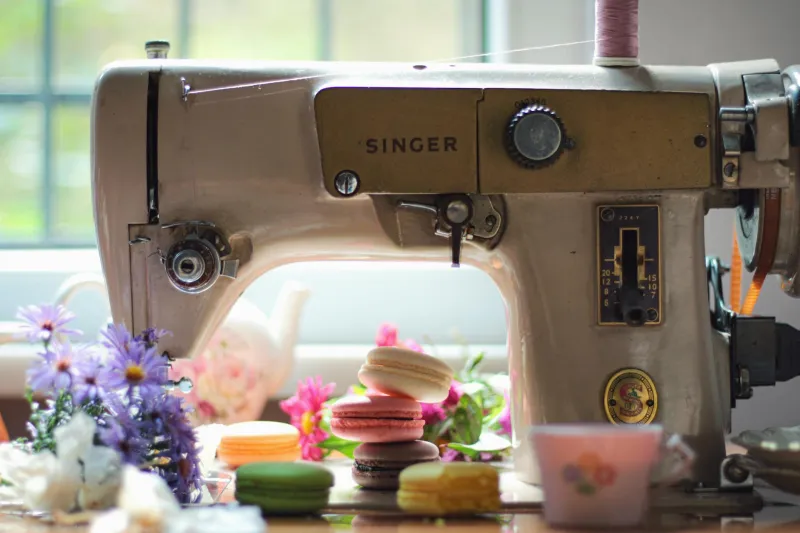
Home sewing wasn't a hobby in the modern sense. It was a domestic skill as fundamental as cooking. Pattern companies like Simplicity and McCall's built enormous businesses in the early-to-mid twentieth century precisely because most American women made a significant portion of their family's wardrobe. The Singer sewing machine, a fixture in millions of American homes, was as essential a household appliance as the stove.
This wasn't nostalgia-worthy frugality for its own sake. It was economic reality. Clothing represented a meaningful percentage of household expenditure, and resources were too tight to waste.
The Department Store and the Democratization of Ready-to-Wear
The shift began gradually, accelerating through the mid-twentieth century. Department stores had existed since the late 1800s, but by the postwar era they had become the dominant force in American retail — and they were selling ready-made clothing at prices that increasingly made home sewing less necessary.
For many Americans, this felt like pure progress, and in important ways it was. Ready-to-wear clothing meant more options, less labor, and access to styles that previously required a skilled dressmaker. The democratization of fashion — the idea that a secretary could dress in a way that looked broadly similar to a wealthy woman — was a genuine cultural shift with real meaning.
Mall culture took this further through the 1970s and 80s. Chains like The Limited, Gap, and Express made affordable fashion available in virtually every suburb in America. Buying clothes became a leisure activity, not just a necessity. The mall trip was entertainment. Consumption was fun.
And then came the real acceleration.
How Fast Fashion Changed Everything
The fast fashion model — pioneered by retailers like Zara and H&M in the 1990s and fully industrialized by the 2000s — didn't just make clothing cheaper. It changed the entire logic of the industry. Where traditional retail operated on two seasons per year, fast fashion chains began producing new styles every few weeks. The goal wasn't to sell you something durable. It was to sell you something new, frequently, at a price low enough that the purchase required almost no consideration.
The economics were made possible by global manufacturing, primarily in countries where labor costs were a fraction of American wages. A shirt that retails for $12 in the US might have been made for less than a dollar in labor costs. The margin exists because the shirt was never meant to last very long.
The numbers that resulted are staggering. The average American now buys roughly 68 garments per year — up from fewer than 25 in 1980. And that 81-pound figure for annual textile disposal? It comes from the EPA, and it represents clothing and textiles combined. The Council for Textile Recycling estimates that only about 15 percent of that material gets donated or recycled. The rest goes to landfill, where synthetic fabrics can take hundreds of years to break down.
The fashion industry is now estimated to produce somewhere between 8 and 10 percent of global carbon emissions — more than international aviation and shipping combined, according to the United Nations Environment Programme.
The Resale Correction (Sort Of)
There are signs of a counter-movement. Resale platforms like ThredUp, Poshmark, and Depop have grown dramatically, particularly among younger consumers. Vintage clothing has had a sustained cultural moment. The concept of a "capsule wardrobe" — fewer, higher-quality pieces — has attracted a genuine following.
But these remain niche behaviors in the context of the overall market. Fast fashion continues to grow globally. The sheer volume of clothing being produced, purchased, and discarded shows no sign of meaningful reversal.
What Changed, Exactly
The honest answer is that clothing stopped being something you had a relationship with. The woman who spent three evenings cutting and stitching a dress knew every seam of it. She'd worn it for two years, repaired it twice, and planned to wear it for two more. The dress meant something in proportion to what it cost her — in money, in time, in care.
A $12 shirt from a fast fashion retailer costs so little, in every sense, that there's no particular reason to value it. And so, largely, we don't.
That's not a moral failing. It's a rational response to the incentives the market built. But it's worth knowing that it wasn't always this way — and that the mountains of discarded fabric filling landfills across the country are the direct result of choices, made over decades, about what clothing should be worth.