The Building That Knew Your Name: What America Traded Away When It Went Digital
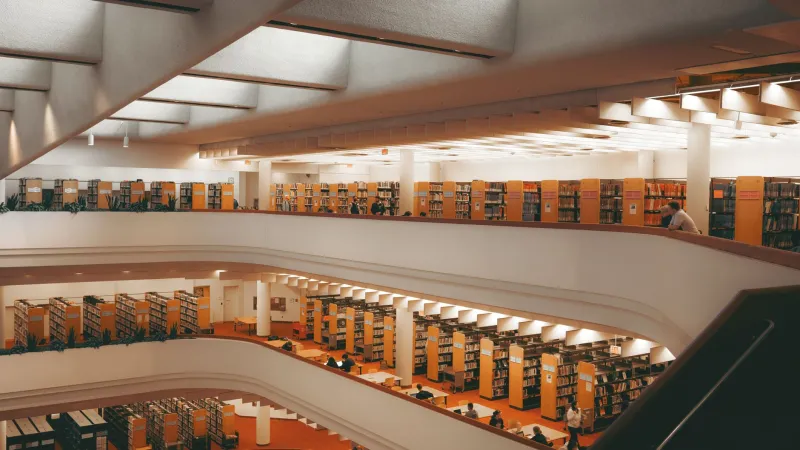
There's a particular smell that anyone who grew up before the internet can identify immediately: the specific combination of aging paper, wood floors, and something indefinably institutional that belonged only to the public library. It wasn't just a smell. It was the scent of a place that mattered.
And it did matter — more than most people today fully appreciate.
The Greatest Equalizer Nobody Talks About
For most of the twentieth century, the public library was the single most democratic institution in American civic life. That's a bold claim, but consider what it actually meant in practice.
A working-class kid in 1955 Cleveland, whose family couldn't afford encyclopedias or subscriptions to academic journals, could walk into the public library on a Tuesday afternoon and access the exact same information as the wealthiest family in town. Same books, same reference materials, same research tools. No paywall, no premium tier, no algorithm deciding what she should probably be interested in.
The library card — typically issued free to any resident — was a genuine passport. It unlocked a world of knowledge that the broader economy would have otherwise placed well out of reach. For immigrant families learning English, for self-educated workers trying to understand their industry, for curious teenagers who'd exhausted what their schools could offer, the library wasn't just convenient. It was transformative.
The Librarian Who Remembered You
But the building itself was only half the story. The other half was the person behind the reference desk.
The mid-century American librarian has been somewhat unfairly caricatured by history — the stern woman with reading glasses and a finger perpetually raised to her lips. The reality was considerably more interesting. A good reference librarian was something between a research partner, a personal curator, and a quiet mentor.
They remembered what you'd checked out last month. They noticed when your reading interests shifted and mentioned something you might not have found on your own. They helped you navigate a research question without doing the work for you, which is a specific and underappreciated pedagogical skill. They treated a twelve-year-old's curiosity about aviation or ancient Rome or electrical engineering with the same seriousness they'd give an adult researcher.
That personalized guidance wasn't a luxury feature. For a lot of American kids — particularly those from homes where education wasn't prioritized, or where books simply weren't present — it was the difference between intellectual development and intellectual stagnation.
Knowledge Had a Location
There's something else worth acknowledging: knowledge having a physical address changed how people related to it.
You had to go somewhere to get it. That journey — even if it was just six blocks on a bicycle — created a ritual. You were doing something intentional. You arrived, you searched, you found or didn't find what you were looking for, and you left with something tangible. The effort involved made the information feel earned.
The library's closing time was a constraint that actually helped. You couldn't fall into an infinite scroll at 2 a.m. You planned your research. You thought ahead about what you needed. The limitation imposed a kind of discipline that, in retrospect, had real cognitive value.
Libraries also created serendipitous discovery in a way that's genuinely hard to replicate digitally. Browsing a physical shelf, you'd pull a book because the spine was interesting, flip through it, and stumble onto a subject you hadn't known you cared about. Algorithmic recommendation engines try to simulate this, but they work by showing you more of what you already engage with — not by introducing genuine surprise.
The Infinite Library Problem
Today, of course, we have access to more information than any human being in history. The sum of human knowledge — or a significant portion of it — sits in the device in your pocket. By any measurable standard, this is extraordinary progress.
And yet.
The democratization of information access that the library represented has not fully carried over into the digital age. Access to a device and a reliable internet connection still maps closely onto income and geography. Digital literacy — knowing how to evaluate sources, navigate research databases, and distinguish credible information from sophisticated nonsense — is unevenly distributed in ways that often mirror older inequalities.
More troubling is the quality problem. The library's collection was curated. A librarian and a selection committee decided what belonged on those shelves, applying standards of accuracy, credibility, and relevance. The internet applies no such filter. The misinformation problem isn't a bug in the system — it's a structural consequence of removing the curation layer that institutions like libraries once provided.
And the sheer volume of available information has created its own paradox. More access has produced, in many cases, more confusion. People who once would have consulted three reliable library sources now wade through thousands of results of wildly varying quality, and many simply give up or default to whatever confirms what they already believed.
What the Library Actually Was
The public library was never just a building full of books. It was a community's collective bet on the idea that an informed citizen was a better citizen — and that access to information shouldn't depend on how much money your family had.
That bet produced something real. Generations of self-educated Americans who used the library as a ladder. Neighborhoods where civic knowledge was shared rather than siloed. A culture of reading that was broad enough to include everyone who showed up.
We haven't replaced that. We've replaced the books. The building, the librarian who knew your name, the ritual of going somewhere to learn something — those are harder to digitize than anyone anticipated. And we're only now starting to understand what their absence actually costs.